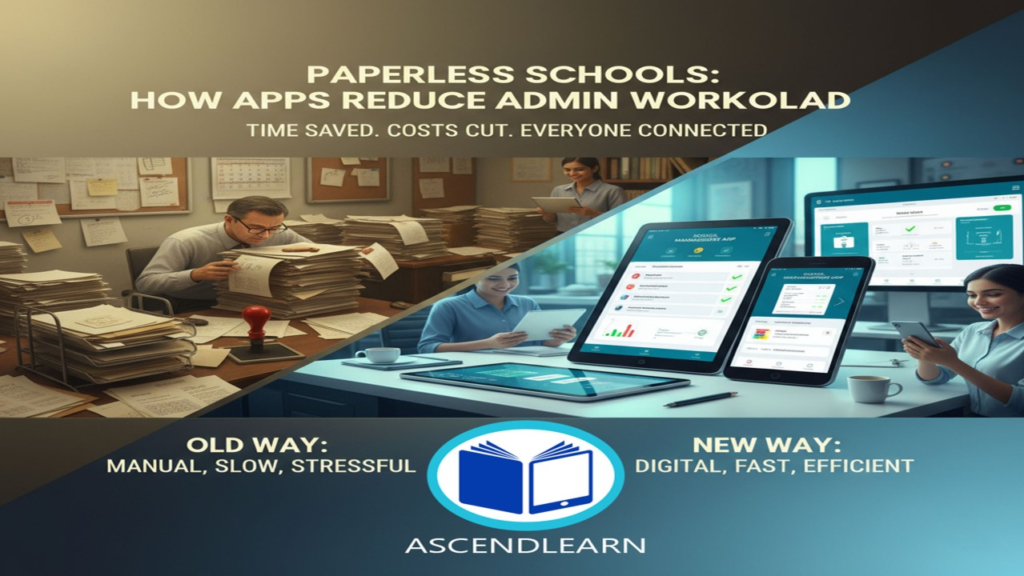
Every school has those invisible walls where work piles up, decisions stall, and frustration builds. Administrative bottlenecks are the silent enemies of school efficiency, and they cost institutions far more than most leaders realize. From delayed fee processing to manual report generation, bottlenecks drain staff energy and slow down the entire educational engine. The schools breaking free from these constraints are doing so with the help of school management software that replaces fragmented, manual processes with streamlined, connected workflows.
Identifying Your School’s Biggest Bottlenecks
Before you can fix a bottleneck, you have to find it. In most schools, the worst bottlenecks cluster around a few predictable areas. Fee collection is almost always one of them, particularly when schools rely on cash payments, manual receipts, and physical ledgers. The process is slow, error-prone, and requires significant staff time at both ends.
Attendance management is another common culprit. When attendance is recorded on paper and then manually transferred to a central system,m or worse, never centralized at all,l finding accurate data becomes an exercise in frustration. Generating a simple absenteeism report can require hours of cross-referencing across multiple registers.
Communication bottlenecks are perhaps the most damaging because they affect relationships. When parents cannot get timely information about their child’s attendance, fees, or academic progress, trust erodes. And when that information has to pass through multiple layers of staff before reaching parents, accuracy suffers at every handoff.
The Cost of Bottlenecks Nobody Calculates
Schools rarely measure the true cost of administrative inefficiency, but the numbers are significant. Consider a school with 1,000 students where five staff members each spend two hours per day on tasks that could be automated. That is 10 staff-hours daily, or roughly 2,000 hours per academic year, equivalent to one full-time employee working purely on tasks a system could handle for a fraction of the cost.
Beyond direct labor costs, bottlenecks create indirect costs. Delayed fee collection hurts cash flow. Inaccurate attendance records create compliance risks. Slow communication damages parent relationships and, in competitive markets, affects admissions. The hidden costs of bottlenecks often dwarf the investment required to eliminate them.
Breaking the Financial Bottleneck
Financial processes are where bottlenecks tend to have the most severe consequences. A modern School Finance Management System eliminates the most common financial bottlenecks by centralizing all financial data and automating routine transactions. Fee collection happens online, with automatic reminders sent to parents before due dates. Receipts are generated and delivered digitally. Defaulter lists update in real time. And month-end reconciliation, which once took days of manual work, happens automatically.
The impact on cash flow is immediate and significant. Schools that move to automated fee collection typically see a measurable improvement in on-time payments within the first term, not because parents are more diligent, but because the system makes it easy to pay and impossible to miss a reminder.
Building a Bottleneck-Free School
Eliminating bottlenecks requires a systematic approach. Start by mapping your current workflows from the moment a parent inquiry arrives to the point where a student graduates. Identify every point where work stops waiting for someone’s input, every task performed manually that could be automated, and every system that doesn’t talk to another system.
Then prioritize. Not all bottlenecks are created equal. Focus first on the ones that affect the most people, consume the most time, or carry the highest risk. In most schools, these will be fee management, attendance tracking, and parent communication,n the three areas where integrated platforms deliver the fastest, most measurable results.
Implement solutions with a clear change management plan. Train your staff, communicate the benefits clearly, and set measurable targets. Within one academic year, a well-executed implementation should show quantifiable improvements in processing times, accuracy, and stakeholder satisfaction.
Conclusion
Administrative bottlenecks are not inevitable; they are a choice. Every time a school chooses to maintain a manual process that could be automated, it is choosing to absorb unnecessary costs, risks, and frustrations. The schools that commit to eliminating these bottlenecks do not just run more efficiently; they create better environments for teachers, parents, and students. The path forward is clear. The technology is ready. Is your school?